Farm & Distribution Packaging

Heavy-Duty Vegetable Crates That Work as Hard as You Do

PP and HDPE crates engineered for the full farm-to-shelf journey. Ventilated for produce freshness, stackable to maximise lorry and cold-store space, and built to survive thousands of wash cycles.

Enquire at Elipacko →
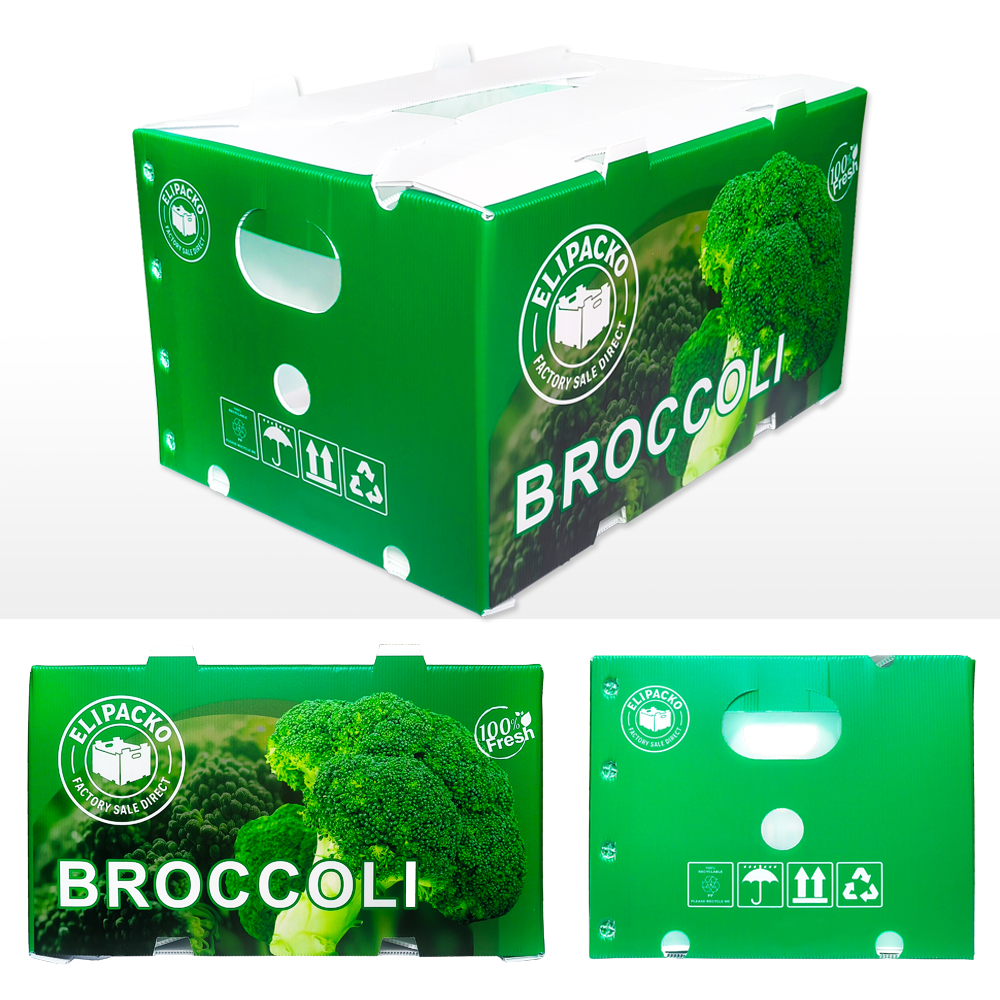
Stackable plastic vegetable crates Fresh vegetables in plastic crates on farm Broccoli in PP produce crate
📦 Size Range 15 L – 60 L
⚗️ Material PP / HDPE
🔁 Reuse Cycles 200 – 400+
🌡️ Temp Range -20 °C to +60 °C
🏗️ Stack Load Up to 250 kg
🚿 Washable Pressure & Chemical

Why Growers & Packers Choose These Crates

Three things set Elipacko vegetable crates apart on the farm and in the distribution centre.

🌬️

Optimised Ventilation

Precision-moulded vent slots on all four walls and the base promote airflow, letting ethylene gas escape and heat dissipate. Potatoes, onions, carrots, and brassicas arrive at the packing line in better condition than they left the field — with less spoilage trim and fewer rejections at the retailer.

📐

Intelligent Stacking

Interlocking rim profiles align automatically when stacked, distributing load to the sidewalls rather than the produce. A full 6-high pallet of 30 L crates stays stable at highway speeds with no banding. When empty, the same crates nest 3:1 to cut return-trip transport costs dramatically.

🧼

Industrial-Grade Washability

Smooth interior radii leave nowhere for soil, mould, or bacteria to hide. PP and HDPE both tolerate high-pressure hot-water wash tunnels and chlorinated or peracetic-acid sanitisers approved for food-contact surfaces. These crates come out of the wash line looking almost new even after hundreds of cycles.

The Full Story Behind a Vegetable Crate

A vegetable crate sounds simple — it's a box with holes in it. But anyone who has watched cardboard disintegrate under a wet potato load, or seen a stack of flimsy crates collapse in a refrigerated trailer, knows the difference good equipment makes. The right crate is a piece of infrastructure that earns its keep over years of service, not a single-use cost that disappears with every shipment.

Elipacko's vegetable crates are injection-moulded from food-grade polypropylene (PP) or high-density polyethylene (HDPE). Both polymers are FDA- and EU-regulation-compliant for direct food contact, odourless, and free of the plasticisers that can leach into produce. PP offers slightly higher rigidity and is preferred for ambient-temperature applications; HDPE is the go-to where more impact toughness is needed — think stone-strewn root-crop lines or rough outdoor conditions.

Size Range: 15 L to 60 L — Why It Matters

Not every vegetable is the same weight per litre. A 30 L crate of potatoes might weigh 28 kg; the same crate of mixed salad leaves barely registers on the scales. Offering sizes from 15 L to 60 L allows operations to match crate volume to produce density so that:

  • Workers are never lifting an overloaded crate — ergonomics compliance is simpler.
  • Transport payload is maximised — no wasted cubic footage on unnecessarily large containers.
  • Packing line flow is optimised — smaller crates for high-value, fragile items; larger crates for bulk root crops.

Common configurations include a 15 L tote used for leeks and brassica heads, a 22 L mid-size for onions and shallots, a 30 L workhorse for carrots and parsnips, and a 45–60 L bulk crate for field-run potatoes before washing and grading. Elipacko can advise on the optimal size mix for your specific crop portfolio.

Ventilation Design: Science, Not an Afterthought

Produce is alive after harvest. It continues to respire, releasing heat, moisture, and ethylene gas. Trap those byproducts and you accelerate ripening, mould growth, and decay. Solid-sided containers — including unventilated plastic bins — are among the primary causes of cold-chain spoilage not attributable to temperature failure.

The ventilation pattern on Elipacko crates is not arbitrary. Slot dimensions and spacing are calculated to achieve a minimum 15% open-area ratio across all four sidewalls and the base, ensuring convective airflow even when crates are stacked tightly on a pallet. The apertures are sized to retain even small produce items like pickling onions or radishes without requiring a liner.

Stackability and Logistics

In a distribution centre moving tens of thousands of crates a day, every second of forklift time is a cost. Crates that don't stack cleanly, that shift under load, or that require manual realignment after each placement are a hidden efficiency drain. Elipacko's stacking profiles engage positive engagement features — shallow lugs on the upper rim fit corresponding recesses on the crate below, creating a column that behaves as a single unit under dynamic load.

This matters at 70 mph on the motorway. A pallet of 6-high loaded crates can experience significant lateral forces through bends and emergency braking. Properly interlocked stacks require no wrap or strapping at normal pallet heights, saving consumable cost and unloading time at destination.

The nesting ratio (typically 3:1 for standard depths) means return logistics costs are a fraction of single-use alternatives. If your crates are doing a 200-km round trip, the transport cost of the empty return is no longer a rounding error on your P&L.

Applications: Beyond the Obvious

While potatoes, onions, and root vegetables are the highest-volume applications, Elipacko crates are in daily use across a wider range of contexts:

  • Mushroom cultivation — the open ventilation suits the high-humidity growing environment; the washable surface survives steam cleaning between flushes.
  • Citrus fruit — the stacking strength handles dense loads; the vents allow forced-air cooling in packhouses.
  • Herb growing — small 15 L sizes work as growing trays and transport containers for direct-to-chef deliveries.
  • Aquaculture and fish — HDPE crates withstand ice, saltwater, and the aggressive sanitisers used in fish processing.
  • Industrial parts washing — outside food entirely, the crates serve as wash baskets in automotive and engineering workshops.

Total Cost of Ownership vs Cardboard and Wood

Cardboard one-trip crates cost between £0.35 and £0.90 each at volume. A PP vegetable crate from Elipacko costs more upfront — but across 300 trips, the per-trip cost drops to a few pence. Factor in the labour to break down and dispose of cardboard, the landfill or recycling costs, and the variable price of corrugated board, and the economics become overwhelming. Wooden crates carry lower initial cost but impose phytosanitary obligations on international shipments, require regular repair, and eventually can't be washed to food-safety standards.

The environmental case is equally strong: a reusable crate used 300 times has a fraction of the lifecycle carbon footprint of 300 cardboard equivalents, even accounting for the higher production energy of a moulded plastic item.

Ordering and Customisation

Elipacko supplies vegetable crates in standard colours (black, grey, red, yellow) for easy line segregation, and can accommodate custom colour compounding for larger orders. Embossed or printed logos, RFID tag receptacles, and barcode label panels are available on minimum order quantities. Lead times, MOQs, and full technical datasheets are available directly from Elipacko's team.

Crate Material Comparison

How PP/HDPE stacks up against the alternatives.

Feature PP / HDPE Crate Cardboard Box Wooden Crate
Reusable ✔ 200–400+ trips ✖ Single use △ Limited / deteriorates
Washable to food-safe standard ✔ Full wash tunnel ✖ Not washable △ Surface only
Cold-chain performance ✔ -20 °C to +60 °C ✖ Weakens when wet/cold ✔ Good
Stackability under load ✔ 250 kg column load ✖ Crushes when wet ✔ Good dry
Nesting when empty ✔ 3:1 nesting ratio ✔ Flat-pack ✖ Bulky
Phytosanitary compliance ✔ No treatment needed ✔ No treatment needed ✖ ISPM-15 treatment required
Per-trip cost (volume) ✔ Lowest over time ✖ Highest cumulative △ Medium

Ready to Upgrade Your Produce Handling?

Get specifications, pricing, and sample availability for the full range of Elipacko vegetable crates — 15 L through 60 L, PP and HDPE.

Contact Elipacko for Pricing →